Month: September 2018
-

Exosuit Designed for Personalized Walking Help
A wearable robotic exoskeleton designed into textiles to provide personalized assistance is shown in lab and field tests to reduce the amount effort needed to walk long distances.
-
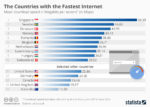
Infographic – Countries with Fastest Internet Speeds
In this weekend’s infographic, we offer a report from the Worldwide Broadband Speed League, a year-long compilation of 163 million Internet speed tests in 200 countries.
-

Patents Awarded for Stem Cell Heart Disease Technologies
A company developing treatments for heart disease using stem cells to regenerate healthy heart tissue received two new patents for techniques supporting its core processes.
-
A Harsh Mountain To Climb — Reasons Your Business Is Struggling
If you think you’re doing everything right, and your business is still limping along, then you need to start digging deeper for the reasons why this is happening.
-

NIH Grant Aims to Make Drugs Taste Better, Not Bitter
A new award from National Institutes of Health funds a study to identify components in taste bud cells that block bitter taste sensations encountered in some drugs and foods.
-

Univ. Spin-Off Developing A.I.-Boosted Heart Monitor
A new enterprise in the U.K. is developing a wearable heart monitor that diagnoses irregular heart rhythms with artificial intelligence using cloud-based algorithms.
-

Gilead Gains Genome-Editing Hepatitis B Therapy
Biopharmaceutical company Gilead Sciences is acquiring a genome-editing technology for treating hepatitis-B, a viral disease affecting the liver.
-
The Future of Health Care
Health care is phenomenally advanced, and advances in the sciences have made it possible to live longer and better than ever before.
-

Personalized Breast Cancer Trial Advances 7 Drugs
A clinical trial with a design that allows for changes in its processes to meet the needs of individual patients says its results helped advance 7 new drugs for breast cancer into review by FDA.
-

Simple, Less Expensive Ultrasound Probe Developed
12 September 2018. Engineers designed a device that sends and receives ultrasound signals with polymer plastics instead of silicon-based circuits, which can lower the cost of medical images. A team at University of British Columbia in Vancouver describes its device in yesterday’s issue of the journal Microsystems and Nanoengineering. Researchers led Carlos Gerardo, a doctoral…